
Osteoblasts
Building Bones and Shaping Strength

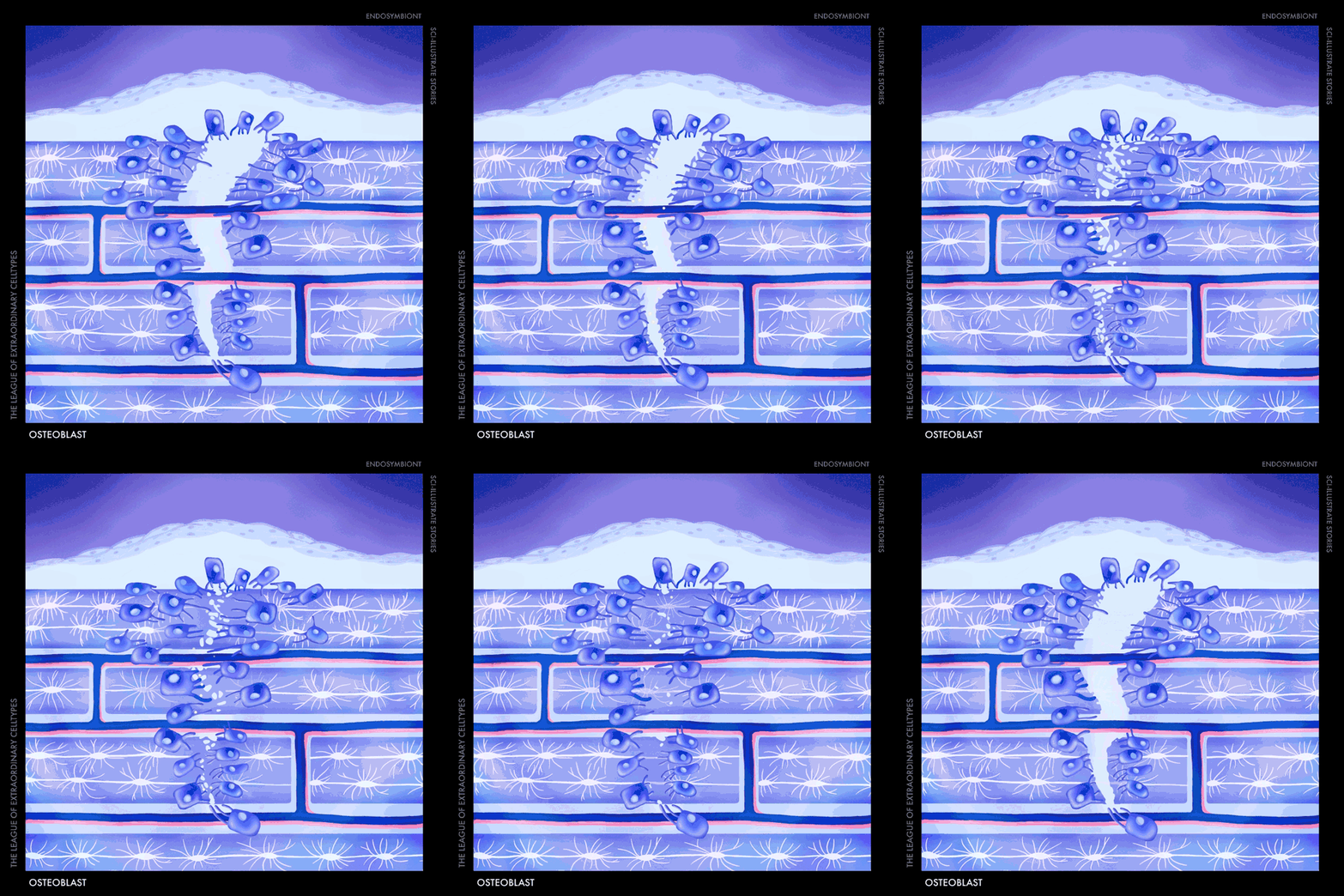
(Originally published on Medium by Sci-Illustrate Stories: The League of Extraordinary Cell Types)
I’m excited to share my latest article with Sci-Illustrate Stories, this time focusing on osteoblasts: the specialized bone-forming cells responsible for building, repairing, and maintaining the skeletal system throughout life.
Most people think of bone as static, but bone is actually one of the most dynamic and metabolically active tissues in the body. Osteoblasts sit at the center of that process, continuously responding to mechanical stress, hormonal signaling, inflammation, injury, and aging to help shape and reinforce the skeleton.
In this piece, I explore how osteoblasts produce and mineralize bone matrix, communicate with osteoclasts and osteocytes during remodeling, and respond to signaling pathways like Wnt/β-catenin, BMP, and IGF-1. I also dive into their emerging roles beyond structural support, including their involvement in endocrine signaling, metabolism, fracture repair, and systemic health.
One of the most fascinating aspects of osteoblast biology is that these cells are not simply passive “builders.” They are adaptive, highly responsive cells constantly integrating environmental, immune, and mechanical signals to maintain skeletal integrity.
At the core of this story is a broader theme I love exploring through science communication: biology is rarely static. Even tissues we think of as rigid and permanent are constantly sensing, adapting, communicating, and remodeling beneath the surface.
🔗 Read the full feature below:
👉 Building Bones and Shaping Strength
🖋️ Credits
Art by Alexandra Banbanaste | Animation by Dr. Emanuele Petretto
Words by Dr. Christy Kestner
Project Coordinator: Dr. Masia Małgorzata Maksymowicz-Trivedi
Series Director: Dr. Radhika Patnala
Published by Sci-Illustrate & Endosymbiont
About the series:
The League of Extraordinary Cell Types
The teams at Sci-Illustrate and Endosymbiont bring you an ongoing series exploring the remarkable cell types that make our bodies function; combining scientific rigor, storytelling, and visual science communication to make complex biology more accessible and engaging ❤
Christy, your article made me think that true strength may not be about never changing, but about continuing to live while adapting and changing. 😇
Hi: I need help from people who love science! Can data center cooling loops recycle electricity from condensation as MIT's groundbreaking 2013 experiments suggest?
As data centers face an unprecedented energy and cooling crisis driven by AI infrastructure, billions are being spent on managing thermal phase changes—specifically evaporation and condensation.
In my latest work at Decoding Science, I’ve outlined a simple backyard citizen-scientist experiment that suggests we fundamentally misunderstand electron behavior during these phase changes. Standard solid-state models predict a neutral net current during condensation on these surfaces, but geometric manipulation reveals a measurable electrical anomaly.
If this anomaly scales, it means the massive humidity and condensation loops already running inside data center cooling infrastructure could be harnessed to harvest electricity directly from waste heat. Perhaps equally significant is how understanding evaporation will facilitate the cooling process.
I’ve laid out the simple, reproducible experiment to prove this effect. Would you be interested in a brief look at how rethinking electron kinetics during condensation could impact the future of data center efficiency?
Best regards,
Thomas Alan White